Is Real the Same as True? The Value of Truth in the Age of AI

admin
||
October 29, 2026
The gap between believing what we see and being sure that what we know is true has never mattered more.
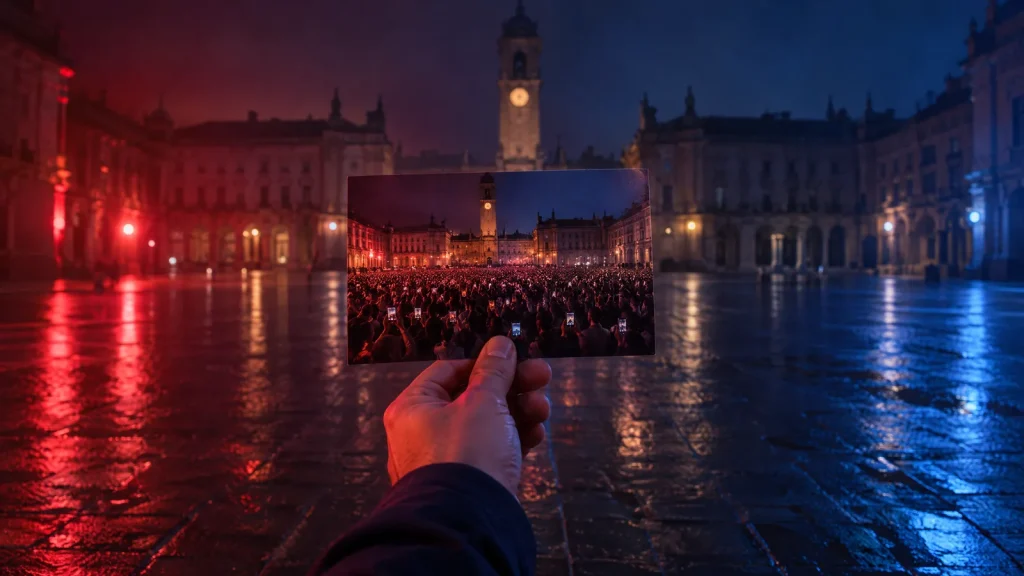
Does what we see have to have happened?
Picture a video: a crowded square, voices rising on their own, natural light moving across faces. The camera shakes; it looks like footage from an amateur witness. Our first impression might be that this must have happened. Yet the footage was generated by AI, and the event it shows never took place. The video file itself is real; the event it depicts is not. This is exactly where the paradox technology has brought into everyday life begins. The distance between a realistic representation and a verified event cannot be closed by judging image quality.
This is not just a new technical issue. One of philosophy’s oldest questions is back in front of us: Does the existence of something prove that a statement about it is true? And, more importantly, why do we trust a story?
Are reality, truth and truthfulness the same thing?
In everyday speech, “real” and “true” are often used interchangeably. Philosophically, reality concerns what exists, while truth is mostly about the conditions under which a statement counts as true. There may be a glass on the table, and the truth of the sentence “there is a glass on the table” depends on the state of the world. But the fact that a photo of the table was genuinely taken does not prove that every claim about where and when it was taken is true.
As the Stanford Encyclopedia of Philosophy shows, there is no single, undisputed theory of truth. Correspondence approaches emphasise the link between a statement and a fact, while coherence and pragmatist traditions ask different questions. For a blog reader, this distinction is not an abstract detail: it is the intellectual basis for asking, “How do we know this?” That a piece of news was shared is a fact; that the news is true requires separate evidence.
The human mind makes meaning before it weighs evidence
Perception is not a neutral copy of the outside world; it is the interpretation of sensory information through expectations, context and experience. The same quiet scene in a commercial can feel elegant to one viewer and distant to another. Two people interpret it differently; this does not mean objective facts don’t exist. It reminds us to keep testing how our interpretations relate to the facts.
Tendencies discussed in psychology, such as confirmation bias, help explain why we accept information that supports our existing beliefs more easily. Seeing a claim repeatedly online can also increase our sense of familiarity. But repetition is not evidence. Critical thinking, then, is not refusing to believe anything up front; it is being able to tell which reasons support which claims.
AI: Is fluent language the same as accurate information?
Large language models can give fluent, well-organised and confident answers. The same system can sometimes present an academic source that does not exist, and do so convincingly. Such errors are often called “AI hallucinations”. The problem is not only that a wrong answer is produced; it is that the error can be delivered in a style that sounds right. When a system generates text, it does not always guarantee, on our behalf, that a source actually exists.
This distinction has a concrete meaning in business. AI can summarise an audience report, classify consumer reviews and suggest communication scenarios. But what data do these outputs represent? Who is missing from the sample? Is a prediction being presented as cause and effect? Good strategy is not just getting fast answers; it is judging which answer can support which decision.
Deepfakes: Is seeing enough to believe?
Photography and film were never free of context. Framing, the chosen moment and editing have always shaped the story. Generative AI has added a new possibility to this old situation: scenes that never happened can now be produced at real-footage quality. That does not mean “AI images are bad”. Historical reconstruction, creative advertising, product design and imagined worlds can all be valuable forms of storytelling. The critical question is how we present the representation to the viewer.
A realistic AI video is not proof that an event took place. The factual accuracy of content, its source and its production method are separate questions. And synthetic content is not automatically misleading: an ad that is clearly labelled as fiction can be more honest than one shot with real people that makes a false promise.
What does authenticity mean in brand communication?
Brand authenticity is often confused with “looking natural”. But being authentic doesn’t mean looking amateur, staying unfiltered or giving up new production technologies. It means building credible consistency between a brand’s identity, its promise and its behaviour. Presenting one real customer’s exceptional experience as if it were standard for every customer can create a misleading expectation, even while using a technically real scene.
In brand positioning, then, the real questions are not only “How should we look?” or “Which video will grab attention?”. Questions such as “What do we stand for?”, “What behaviour backs up this promise?” and “What do we want the viewer to understand?” matter more. In NeoMinds Media’s approach, which brings human insight and AI together, technology expands how stories are produced, while judgement about a story’s accuracy, context and ethical consequences remains part of the strategic work.
Conclusion: Realism can be produced; trust has to be built
Today we can visualise a place that never existed, voice a sentence that was never said and recreate a moment that never happened. That is a powerful opportunity for creative expression. But however impressive it is, an image’s aesthetic success does not, by itself, prove that the claim it makes is true.
The skill that will make the difference in future communication may not simply be producing more content. Saying clearly what a piece of content represents, asking what verifies a claim, and not spending the audience’s trust for short-term impact may become more valuable. Realistic images can be produced. Truth is researched and tested. Trust is earned over time.
References and further reading
- Stanford Encyclopedia of Philosophy — Truth
https://plato.stanford.edu/entries/truth/ - Stanford Encyclopedia of Philosophy — Epistemology of Artificial Intelligence
https://plato.stanford.edu/entries/epistemology-ai/ - TÜBİTAK Bilim Genç — Why do AI models hallucinate? (in Turkish)
https://bilimgenc.tubitak.gov.tr/makale/yapay-zeka-modelleri-neden-halusinasyon-uretir - Istanbul University — Synthetic media in the post-truth era (in Turkish)
https://iupress.istanbul.edu.tr/tr/journal/4boyut/article/hakikat-sonrasi-cagda-sentetik-medya-olgusu-gerceklik-algisi-ve-etik-sorunsali
CATEGORIES