AI Superhuman: Silicon Brain vs. Carbon Brain
On the path to a superhuman, is the silicon brain of AI or the carbon brain of humans ahead? We compare the two and argue the winner is a partnership.
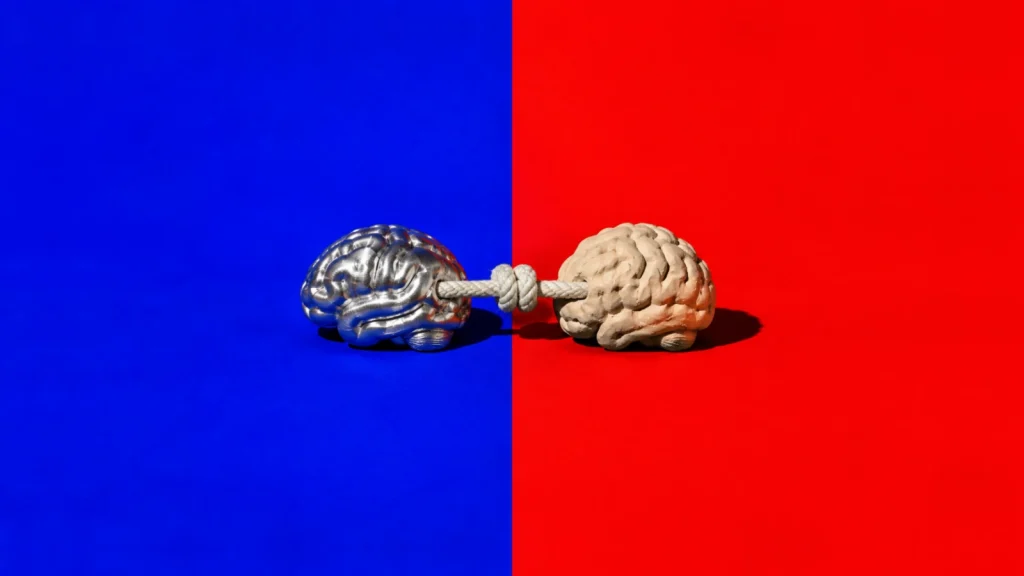
On one side, a mind made of silicon that never tires. On the other, a brain made of carbon that runs on about 20 watts and can feel. On the road to a superhuman, which one is ahead?
First, let's define "superhuman"
The debate often starts on the wrong foot, because everyone means something different by “superhuman.” There are three possible meanings:
- Superintelligence: AI itself becomes a mind that leaves humans behind in every field.
- The augmented human: Humans use AI as an extension of themselves and push past their own limits.
- The evolved human: Humans improve themselves, biologically and mentally.
The answer depends on which one we mean. In this article we focus on the second, but we will weigh the first honestly too.
Two brains, two kinds of physics
AI runs on silicon: fast, copyable, scalable. The human brain is carbon-based: slow, a single copy, but bound up with the body, emotion and lived experience. Comparing them does not show which is “better”; it shows what each is strong at.
- Speed and volume: silicon is very strong; carbon is limited.
- Memory and recall: silicon is broad and lossless; carbon forgets but picks what matters.
- Scaling: silicon can be copied and multiplied; carbon is one person, one lifetime.
- Energy efficiency: silicon needs a lot of energy; carbon runs on about 20 watts.
- Embodied experience: absent in silicon, only indirect; present in carbon.
- Intent and values: given from outside in silicon; carbon carries and chooses its own.
- Taste and intuition: silicon imitates; carbon acquires them by living.
Where silicon wins
AI has already passed humans in speed, volume and consistency. It can test thousands of scenarios at once, write in hundreds of languages and work day and night. That is a large part of the answer to “which jobs will AI change?”: repetitive work that needs volume and speed.
Where carbon wins
Humans decide what matters. They feel why a brand exists, why a story touches people, why an idea is right at the right moment. AI produces what “looks good”; choosing what is “right” is still human work. And the carbon brain lives: it tires, it suffers, it rejoices. Meaning comes from there.
The real answer: a superhuman is a partnership
We think “who is ahead?” is the wrong question. Silicon alone may approach superintelligence, but then it steps outside the idea of “human.” For people, the path to becoming superhuman is to make silicon an extension of the carbon mind: the next step after the pen, the printing press and the calculator, only far more powerful.
We see this in advertising every day. The “traditional agency vs. AI agency” debate is often incomplete: the winner is not the agency that uses AI the most, but the one that balances human judgment and AI power well.
The danger: A person who outsources thinking entirely does not become superhuman; they weaken their own carbon muscle. This is the flip side of the brain rot debate: AI can strengthen us, but it weakens us if we stop using our minds.
Who is on the path to superhuman?
- AI: Ahead in power and speed, but still takes its intent and values from humans.
- Humans alone: Strong in meaning and judgment, but limited in scale and speed.
- Humans + AI: For now, the closest and most realistic candidate for a superhuman.
Conclusion
A superhuman is not silicon beating carbon; it is carbon using silicon for its own purposes. In this race, the one who pulls ahead will not be the one who trusts AI the most, but the one who knows best how to direct it.
That is why NeoMinds Media puts AI next to the human mind, not in its place. Join the debate: who do you think is ahead on the path to superhuman?
Sources
- Ling, J. — Power of a Human Brain, The Physics Factbook, 2001
https://hypertextbook.com/facts/2001/JacquelineLing.shtml - Kováč, L. — The 20 W sleep-walkers, EMBO Reports, 11(1), 2010
https://pmc.ncbi.nlm.nih.gov/articles/PMC2816633
CATEGORIES