Are Algorithms Really Intelligent? What a Child Can Teach Us About Learning

admin
||
October 29, 2026
The differences between a child exploring the world and a machine extracting patterns from data are as instructive as the similarities.
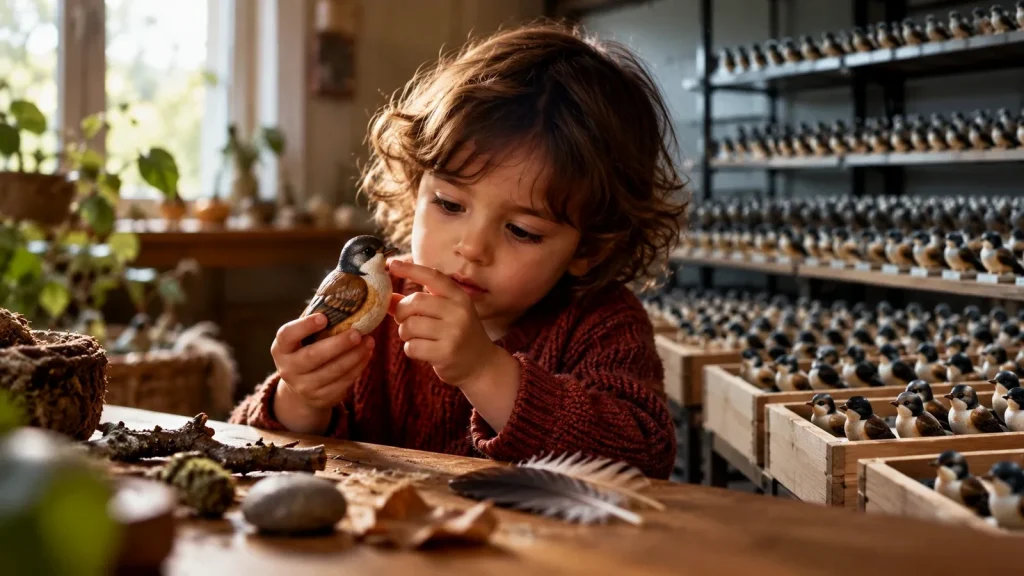
How does a child learn about the world?
A child drops an object, hears the sound it makes and reaches for it again. An adult says the object’s name. The child hasn’t just heard a word: they have experienced movement, sight, sound, shared attention and a social response all at once. It’s easy to romanticise this example, as if human learning were entirely intuitive and machine learning entirely mechanical. Yet research keeps complicating this simple contrast.
Machines can also learn statistical relationships from data and generalise to new examples. The debate should start with the sense in which we use the question “Is it learning?”. Learning a task and experiencing the world as a human does are not the same claim.
What does 61 hours of a child's experience tell us?
A study by Wai Keen Vong and colleagues, published in Science in 2024, used roughly 61 hours of video and simultaneous speech recordings drawn from a single child’s experience between the ages of 6 and 25 months. The researchers showed that a neural network trained on this limited visual-language data could learn some word–object mappings and, in certain tests, generalise to new visual examples.
This finding matters because it challenges simple narratives that learning is only possible with huge, internet-scale datasets. But what the study proves should also be kept in proportion. A model learning certain mappings from one child’s recordings does not mean it reproduces a human child’s whole language development, bodily experience or consciousness. The study’s strength lies precisely in its narrow but revealing question.
What is an algorithm, and what does “learning” mean here?
An algorithm is the general name for a finite, defined sequence of steps for solving a particular task. Not every algorithm is AI, and not every algorithm learns from data. In machine learning, a system can improve its performance on certain tasks by drawing on patterns in its training data. This process works differently in different models.
“Learning” here is a behavioural and technical definition. A model correctly classifying a new image may indicate that it is generalising within the task. But it doesn’t follow that its intentions, subjective experience or way of making meaning are the same as a human’s. Using words deliberately makes the debate more productive.
Little data, lots of data: Why is the simple comparison not enough?
“A child learns from a few examples; AI needs millions” is an effective slogan, but it isn’t true in every case. Children also have rich sensory and social experiences over long periods. On the other hand, some machine learning systems can adapt to certain tasks with few examples, and large models carry substantial knowledge from their pre-training. If the tasks and types of data being compared aren’t equivalent, putting the numbers side by side is misleading.
The real question is which context a system uses, and to what extent. A child doesn’t simply hear a word; they build meaning through gaze, behaviour and interaction. When evaluating a model’s performance, we need to know the scope of its training, the tests used and the limits of the success claimed.
Why do body, relationships and culture matter?
Human learning is not just accumulating information. The body’s relationship with its environment, guidance from other people, the cultural use of language and mutual expectations all play a role. The word “warm” can describe touching a warm object, someone’s warm manner or the weather. What determines a word’s meaning is not only statistical proximity but lived context.
This doesn’t mean machines can’t generalise anything. On the contrary, the generalisation capacity of modern models is one of the most interesting areas of research. But turning a scientific success into a single conclusion that explains all human abilities is unfair to both the technology and human learning.
Do marketing algorithms really understand customers?
Brands can get predictions from algorithms about purchase likelihood, content interest or churn risk. These predictions can be useful for budget planning and personalisation. But a customer’s click is not a complete explanation of why they clicked. A person’s silence can mean satisfaction, indifference, a lack of options or some other reason.
Strategic communication requires researching the context of behaviour as much as measuring it. Data analysis, qualitative interviews, field observation and human judgement can be used together. For NeoMinds Media, this is exactly where the value of creative decision-making lies: discovering what people truly care about and turning it into a meaningful story. Technical personalisation alone is not empathetic communication.
Conclusion: From the “intelligent” label to better questions
“Are algorithms stupid or intelligent?” is an attention-grabbing question; but instead of choosing one extreme, it’s more useful to define capability. What did it learn, in which task? What data was it trained on? How robust is it in new conditions? Where does it get things wrong? Scientific evaluation moves forward with these questions.
Understanding human learning and machine learning requires comparing the two without belittling either. Perhaps what matters most is not how closely a machine resembles a human, but which questions we use it for and under what oversight.
References and further reading
- Vong et al., Science (2024) — Grounded language acquisition through the eyes and ears of a single child
https://pubmed.ncbi.nlm.nih.gov/38300999/ - Nature — Can lessons from infants solve data-greedy AI?
https://www.nature.com/articles/d41586-024-00713-5 - TÜBİTAK Bilim Genç — Is AI learning similar to a child learning language? (in Turkish)
https://bilimgenc.tubitak.gov.tr/makale/yapay-zeka-ogrenmesi-bir-cocugun-dil-ogrenmesine-benzer-mi - TÜBİTAK Encyclopedia — Artificial Intelligence and Machine Learning (in Turkish)
https://ansiklopedi.tubitak.gov.tr/ansiklopedi/yapay_zeka_ve_makine_ogrenmesi
CATEGORIES